
Meditation Four ✌️✌️

Day four ☺️
As I type this my mind is focused on striking the correct keys, and spelling-ish, and sentence structure-ish.
Meanwhile, I hear the sound of my ceiling fan humming away and can feel its slight breeze. I feel the weight of my body against my chair, and a slight pain in my knee.
Meanwhile, my body alone is fulfilling any billion of necessary and involuntary functions. Cells are dividing, and doing other cell stuff, digestion is occurring, and nutrients are extracted and things are “filtered.” Some things are even “growing.”
All those functions—inputs, signals—are transferred via our senses via “signals” themselves—electrical, chemical, “science-y” stuff, etc.—into our brain which, somehow, results in our “unity of consciousness.” Our “I” of who we “Are.” Our identity.
Or, that part of me that’s currently trying to remember how to spell consciousness.
When Rene Descartes left us yesterday, we had “hope” in the form of a perfect blackboard God that now Exists. Best part, he’s really cool, because he’s perfect. That means he is not a “deceiver.”
But, and there’s always a but, Rene realizes he’s got a problem. In Meditation One, Rene was pretty clear on the notion that human beings “make mistakes.” He noted mistakes—in math, in perception, in judgment.
If God created humans, and God is perfect, like blackboard God perfect, and really super cool, then why did he make us so “fallible” 🤷🏻♀️
In short, why did He give us a mind that gets things wrong?
Rene begins by assigning blame. It’s me God, not You. After all, the “source of error” can’t come from God, because deception or imperfection cannot originate from a perfect being like God. So, error must arise from the structure of the human mind itself.
So, “Honestly, it was pear-shaped from the start.” Or, the “Fourth Meditation: Of the True and the False.”
Rene starts by examining the human mind. our vat “I” His thinking and perceiving “him.” In a vat.
He concludes that we possess two main faculties: the intellect (understanding) and the will (choosing/judging).
He explains that the intellect is the faculty of understanding; it perceives ideas and judges their truth.
In another way,
At night, everything unnecessary falls away.
What remains is this:
The intellect is the quiet light. It does not “choose.” It does not “act.” It simply reveals. It shapes truths, outlines, and whatever can be seen clearly, it shows.
The will is movement in the dark. It does not “see.” It does not “illuminate.” It reaches. It affirms and denies. Even where there is no light. It is unafraid to take a step past the edge of the light.
[Sorry, it’s poetry month 🤷🏻♀️🤦🏻♀️]
Back to Rene, the intellect is limited. It only understands clearly and distinctly a finite number of things. By contrast, the will, our capacity to affirm, deny, choose, or suspend judgment, is unlimited. We can make decisions about anything, even when we don’t know the consequences.
This is a crucial shift in philosophy. Instead of attributing human error to fate, divine will, or sensory “illusions,” Rene grounds error in a mismatch between our faculties. Humans have free will, but with freedom comes the ability to fuck up.
This has important consequences. If error comes from the misuse of free will, then responsibility for error lies with the human being, not with God. That preserves God’s perfection and simultaneously affirms human agency. We are not passive recipients of truth; we must actively govern our judgments.
Rene now offers a test for knowledge. We can have it, but only if we stick to what we (high peaks)clearly and distinctly understand.
Are we just victims of confusion or fate? Rene says No. We have free will and we are responsible for “how we judge.”
In other words, You have the ability to know truth (to turn on your light of intellect) and You have the ability to decide what’s true (the will).
For Rene, “Truth” (big T Truth) happens when those two are aligned. Error happens when the will moves ahead of the light of evidence and the fruits of your intellect.
To quote directly,
“We possess the tools to reach truth, but we must use them carefully.”
TLDR: ☺️
You’re not broken 💕
Reality isn’t rigged against you 💕
But you can mess up — and when you do, it’s usually because you jump to conclusions.
The most important thing here is how he reframed “morality.” In 1641, it was not uncommon to attribute bad things to God’s will and other things to demon possession or witchcraft. But, Rene reframes our morality to our own will. Our free will. Our judgments.
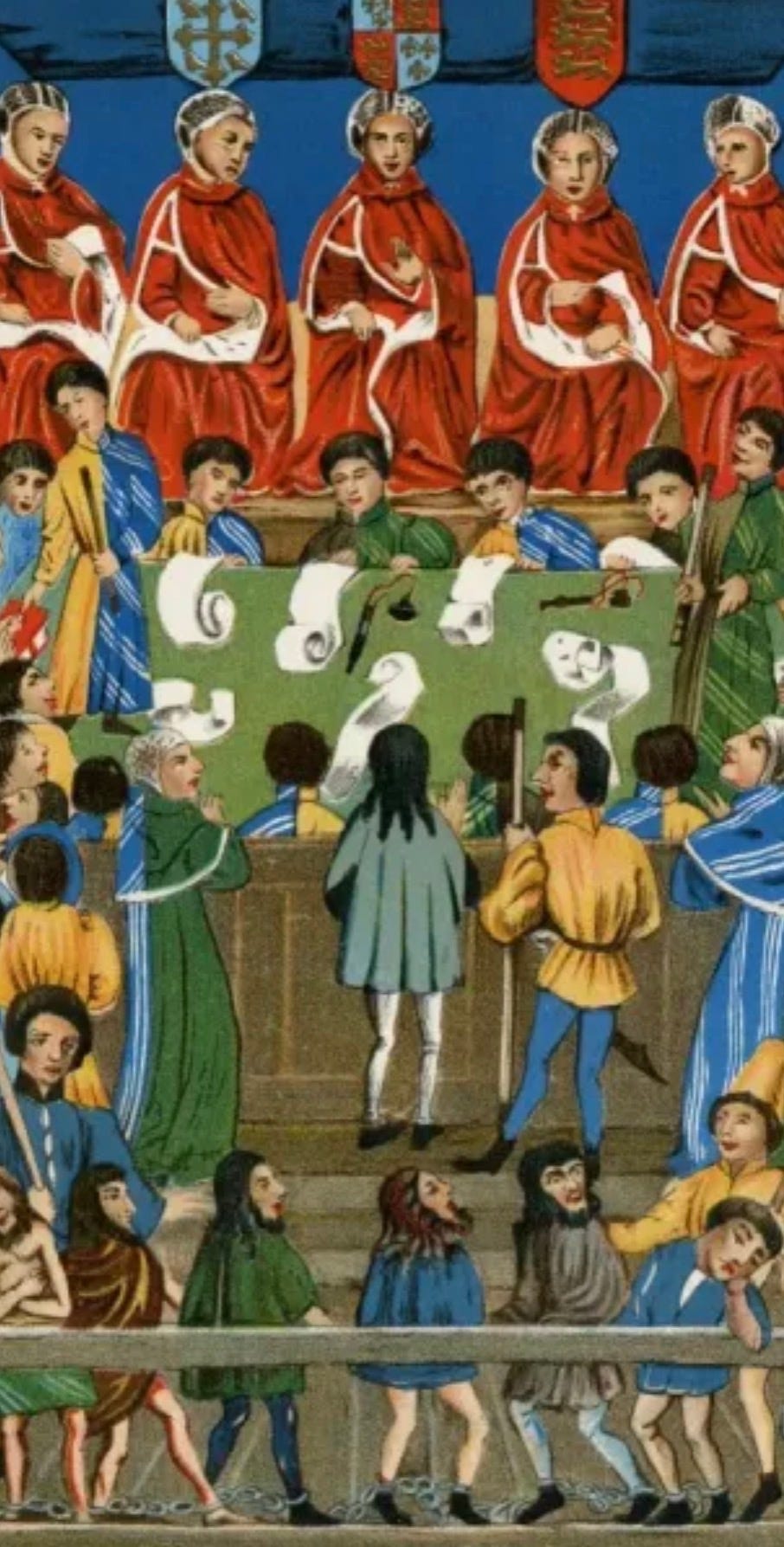
Punishment with “mens rea.”
In law, mens rea is the mental state required to commit a crime. Basically, what was going on in the person’s mind.
Did they intend it? Did they know what they were doing? Were they reckless or negligent?
I’ve spent more time with ethics than epistemology. But free will is a necessary component in morality.
Here what’s notable to me, what’s hidden in Meditation Four.
Rene is focused on error and judgment, but underneath it, what he does is he splits the mind (our thinking and receiving “I” in a vat) into the “intellect” and “will.” He treats both as purely mental faculties.
He explains it without appealing to the body at all. That’s the key ☺️
Up to this point, the body is still kind of… irrelevant 🤷🏻♀️
In fact, sensory experience is still under “suspicion.” But, we have a path toward Truth grounded in “clear and distinct” ideas in the mind. And, yes, there is definitely a lot of there in there.
So Rene is effectively saying: Everything that matters for truth, error, and knowledge happens in the mind alone.
That’s a big deal.
Because once you do that, you’ve implicitly created a world where: The mind is self-sufficient and The body is not needed to explain “thinking.”
I may have a penis, but I don’t think with her any more than I think with my elbows or my tits.
Tomorrow, we talk about things, and more God, and more mind/body problem ☺️
Thank you for reading ☺️
Sam 💕
Court:
Nice very good.